
In-Ovo Sexing Quarterly Roundup: Q3 2026
EU reaches 40% in-ovo sexing adoption
In July we released our 2026 In-Ovo Sexing Market Penetration Report, tracking the state of adoption for the technology around the world. Some highlights:
-
The European Union has now reached 40% in-ovo sexing adoption, up 6 percentage points from last year. It is expected to cross 50% adoption by 2028.
-
In Switzerland, in-ovo sexing is used in 85–100% of the country’s layer flock. In Norway, in-ovo sexing has 52% market penetration.
-
The United States is currently at 1% adoption, and will hit 4% as committed producers complete their transitions.
-
In-ovo sexing technology has reached a production rate of 100 million female chicks per year. Since 2021, over 281 million male embryos have been removed before hatching globally.
You can read the full report here.
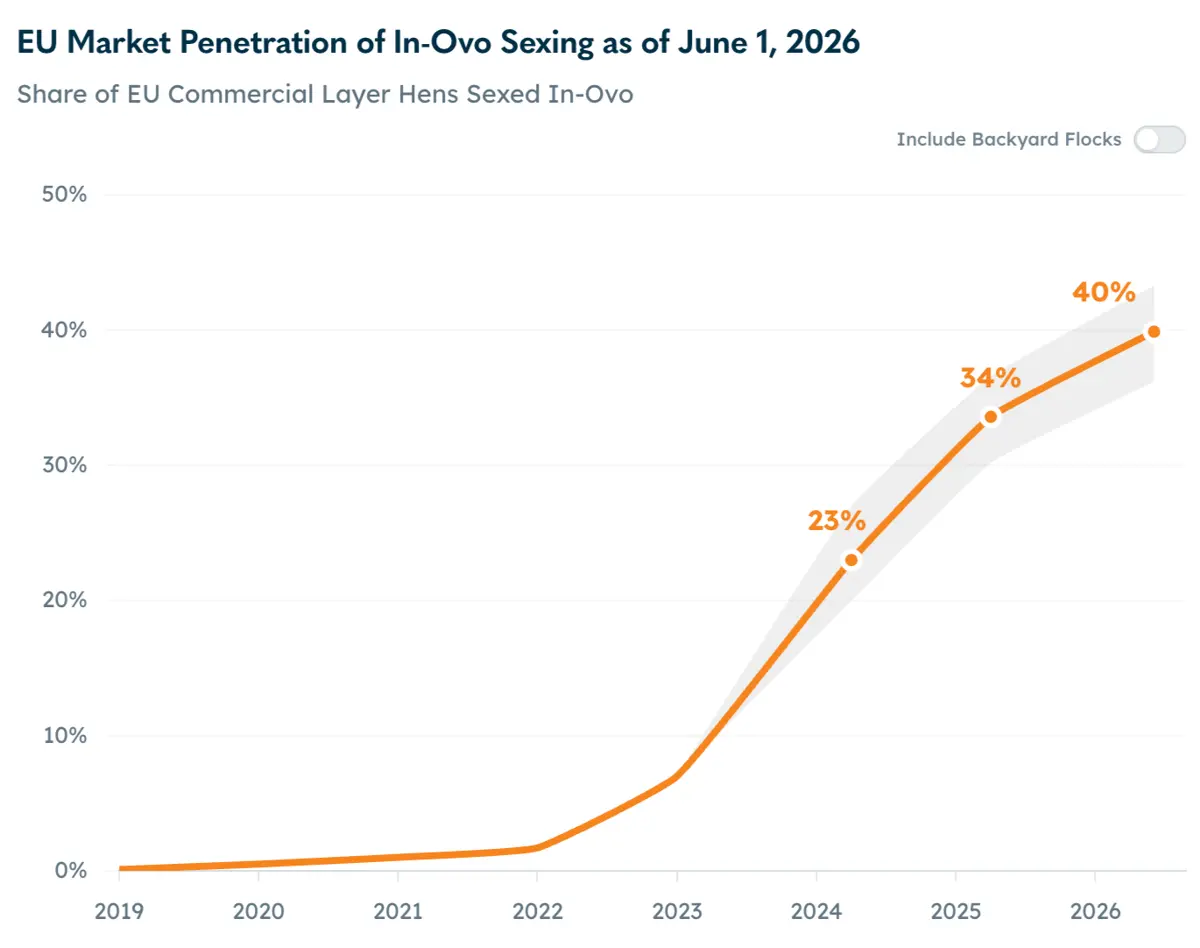
Chart showing EU in-ovo sexing adoption from our market penetration report
European Commission telegraphs full EU transition from chick culling
In July, the European Commission published its first EU Livestock Strategy, a policy report intended to serve as a roadmap for a “sustainable, competitive and resilient livestock sector”. In the report the Commission states that by the end of 2026 it intends to propose a revision to EU animal welfare rules to end the practice of chick culling in all EU member states. The report is framed tentatively, and does not suggest specific timelines for a transition.
EW group recently hosted European parliament members at its Pluriton hatchery in Bladel on the back of these discussions. At the hatchery, parliament members saw in-ovo sexing technology in commercial production first-hand. After the trip, EW Group noted that, “Whether the culling of day-old male chicks can be ended is no longer the question. The question is how we arrive at a workable solution within the EU.”
In other European news, the managing director of Lohmann Deutschland, one of Germany’s largest layer hatcheries, recently gave an interview revealing that in-ovo sexing now accounts for 95% of Lohmann’s conventional chicks and 80% of its organic chicks.
Brazil hosts in-ovo sexing conference
In August of this year, Brazil convened its first National In-Ovo Sexing Meeting in São Paulo. The workshop had over fifty attendees, spanning producers, technology providers, government agencies, and financial firms, as well as Innovate Animal Ag’s Gabriela Menin. The conversation focused on economic questions and discussed the public financing options available to hatcheries. The Ministry of Agriculture (MAPA) confirmed that it is developing a poultry welfare normative on chick culling, with publication expected in early 2027. These normatives detail how existing laws should be interpreted and implemented and signal to producers MAPA’s views on particular issues. Following the conference, many of the in-ovo sexing companies also attended SIAVS, Brazil’s largest animal protein trade show.
In September, a bill was introduced to Brazil’s Chamber of Deputies that would ban the culling of male layer chicks after hatch. The ban would take effect 36 months after the law is published. The bill pairs the ban with a dedicated federal credit line for hatcheries, genetics companies, egg producers, cooperatives, and in-ovo sexing service providers. The credit line would cover equipment, facility work, software, installation, and training, with financing of up to 100%, favorable interest rates and grace periods. The bill is moving in parallel with MAPA’s poultry welfare normative.

IAA’s Gabriela Menin speaks at the São Paulo in-ovo sexing conference
NestFresh reaches 1.2 million chicks sexed
NestFresh recently announced a new milestone in their in-ovo sexing progress. The company has now sexed 1.2 million chicks in-ovo, and expects to reach 1.5 million by the end of 2026. The company first began using in-ovo sexing in summer 2025 with its Humanely Hatched product line, and since then it has expanded in-ovo sexing to their other brands, including New Barn Organics and Country Hen. “Two years ago, in-ovo sexing was still something the industry was hesitant to talk about,” said Jasen Urena, Nest Fresh’s Vice President. “We believed it could become a real, scalable solution, and we made the decision to invest in making it a reality. Today, 1.2 million chicks later, we’re proving that humane innovation isn’t just possible at commercial scale, it’s already making a measurable difference.”
Orbem and AAT announce new installations
In a July article from AgFunderNews, Orbem shared details on its current and future US operations. Orbem machines are now operational in two US hatcheries, with a third US installation planned for 2027. The company did not share which hatcheries were involved, but hinted that this project had buy-in across the supply chain. “We expect an announcement from one of the big retailers very soon,” says head of global business development Jennifer Volz.
The company shared insight into the American market in a recent post on their website: “Once a major buyer commits to sourcing in-ovo sexed eggs at scale, the rest of the supply chain follows. That commercial tipping point in the US is still ahead of us, but the infrastructure to meet it is already in place.”
AAT also announced that it installed a new Cheggy in the Novoponte SAS hatchery located in Juigné-sur-Sarthe, France. The installation went live in July of this year. The company now operates a total of seven machines across three hatcheries in France. “France remains one of the most important markets for Cheggy, and this new installation at Novoponte underlines the continued momentum we are seeing across the country,” said Jörg Hurlin, Managing Director of Agri Advanced Technologies.
Italy debates funding for its chick-culling ban
In September, members of Italy’s Senate filed three amendments that would help hatcheries pay for in-ovo sexing equipment ahead of the country’s ban on male chick culling, which takes effect at the end of 2026. The proposals are attached to the government’s broad agriculture bill. They range from €5 million to €10 million per year in direct investment support for 2026–2028, to setting aside 5% of Italy’s “Nuova Sabatini” subsidized-loan program for hatchery sexing machines. Similar proposals failed during Italy’s 2026 budget debate and again in the Chamber of Deputies in July. In that debate, Agriculture Minister Francesco Lollobrigida said the government would instead support the transition through its Food Sovereignty Fund.
For more detailed information on in-ovo sexing technologies and their impact on the poultry industry, visit our In-Ovo Sexing Overview.