
In-Ovo Sexing Quarterly Roundup: Q1 2026
Welcome to Innovate Animal Ag’s Q1 2026 in-ovo sexing roundup, where we dive into the latest updates surrounding the technology. The first quarter of 2026 brought new commercial transitions in the United States, a major funding round for one of the technology’s leading providers, and a milestone regulatory announcement from Norway.
Business Roundup
- NestFresh won the 2026 NEXTY Award in the Dairy or Egg Product category for its Humanely Hatched Pasture Raised Eggs. The NEXTY Awards recognize excellence and innovation in retail products, and the win puts in-ovo sexing in front of a broad audience of retailers, distributors, and food industry professionals. Whole Foods also recently included NestFresh in their 14th annual supplier all-star awards, given to brands that demonstrate product excellence. NestFresh was the first company in the US to adopt in-ovo sexing, and it began selling its Humanely Hatched eggs in Summer 2025. It also recently expanded in-ovo sexing to cover its New Barn Organics and Country Hen product lines.
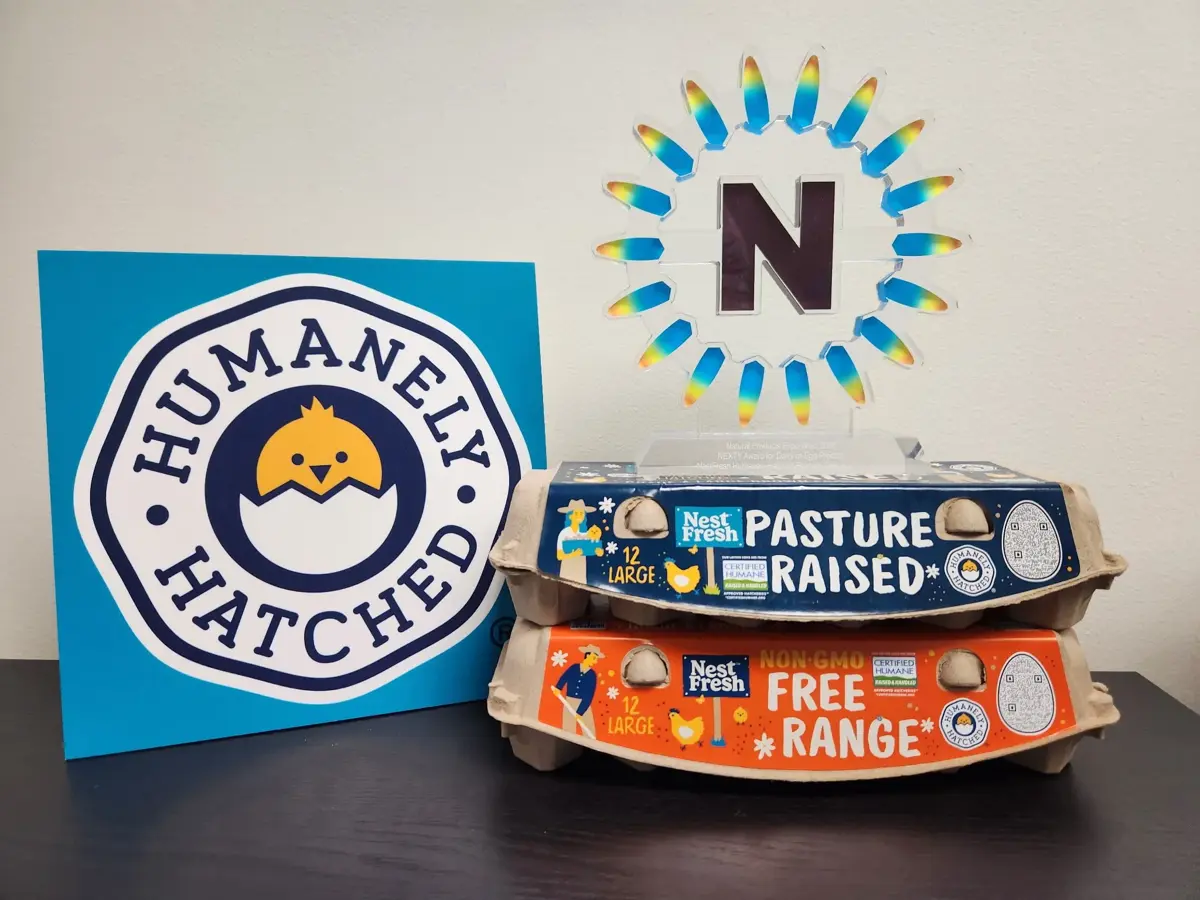
NestFresh’s NEXTY Award on top of their Humanely Hatched packaging
-
In January, Evermore Pet Food became the first U.S. pet food brand to adopt in-ovo sexing for its eggs, announcing a total transition to in-ovo sexed eggs by the end of 2026. By sourcing NestFresh’s Humanely Hatched eggs, Evermore is ensuring that its Certified Humane™ pastured eggs meet the highest welfare standards from the very start of the bird’s life. The announcement marks an important expansion of in-ovo sexing beyond the table egg market and into adjacent sectors.
-
In February, American producer Sauder’s Eggs announced that it is adopting in-ovo sexing for many of its specialty product lines, including Free Range, Free Range Organic, Pasture Raised and Pasture Raised Organic eggs. The company is partnering with Hy-Line to sex its chicks using the Cheggy machine, and plans to have finished its rollout by August 2026. This news makes Sauder’s the fourth company in the US to publicly adopt in-ovo sexing, alongside NestFresh, Vital Farms, and Kipster.
-
Orbem, the Munich-based developer of AI-powered MRI technology for in-ovo sexing, closed a €55.5 million Series B funding round in January. The round was led by European deep tech specialist Innovation Industries and joined by Supernova Invest, with follow-on participation from existing investors General Catalyst, 83North, The Venture Collective, and Possible Ventures. Orbem plans to use the funding to expand into the U.S. market, scale its poultry solutions, and extend its platform to new verticals including food quality inspection and healthcare. The raise is a strong vote of confidence in the commercial viability of in-ovo sexing and positions Orbem to compete more aggressively with AAT’s Cheggy system, which currently has the largest hatchery presence.
-
In Brazil, Raiar Orgânicos’s eggs from in-ovo sexed hens are now on shelves, marking the first time that Brazilian consumers can purchase eggs produced with this technology. Raiar opted not to increase the price of their eggs, indicating they have faith in the economic benefits of the switch. Raiar’s first chicks were hatched using AAT’s Cheggy technology at a Hy-Line do Brasil hatchery in mid-2025, and the eggs arrived on shelves on schedule after an 18-24 week maturation period. Raiar has decided to convert its entire flock to in-ovo sexed hens, making it the leading adopter in Latin America.
Policy & Regulation
- Norway established a national target date to finish its in-ovo sexing transition. In January, Nortura SA and the Norwegian Meat and Poultry Industry Association announced that on July 1, 2027, in-ovo sexing will become the industry standard across the country. This move is an interesting inversion of the transition that occurred in other European countries; it comes after the Norwegian egg industry (led by producer Steinsland & Co.) has already shifted a significant amount of its production toward in-ovo sexing. With this news, Norway has joined the likes of Germany, France, Italy, Switzerland, and the Netherlands in transitioning fully to in-ovo sexing.
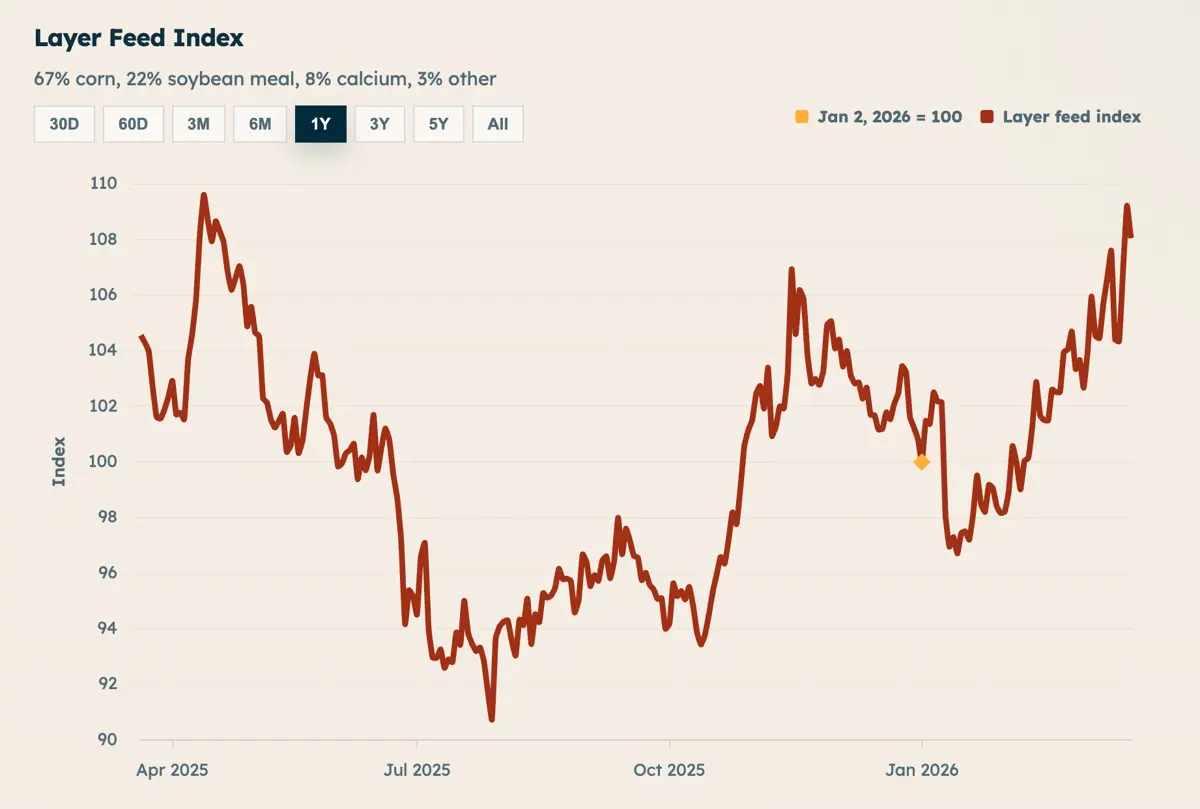
Input costs of layer feed from our monthly Egg Industry Executive Chartbook
New Research
-
Innovate Animal Ag released our montly edition of the Egg Industry Executive Chartbook, a comprehensive data resource tracking key metrics across the poultry sector. If you’re not already subscribed, you can view this month’s chartbook here.
-
We also launched our HPAI Dashboard, a tool for tracking the latest data on HPAI outbreaks and its impact on the industry. Monitor commercial poultry operations, wild bird detections, livestock and dairy herd infections, mammal cases, and wholesale egg price impacts - updated regularly from USDA APHIS and USDA AMS sources.
For more detailed information on in-ovo sexing technologies and their impact on the poultry industry, visit our In-Ovo Sexing Overview.